The criticism that is valid against Kant is valid against later idealism as well. All idealism is at a loss to interpret the phenomenon of error or evil. As was already noted earlier it will not do to limit the question of error to individual instances and ask how I may be sure that any particular thing will be true. If I am able to doubt one particular thing I thereby doubt the whole, when the whole is so related as Kant and Hegel would have us believe. We then find ourselves in an irremediable dilemma and in desperation proclaim; 'the rational is real and the real is rational,'and help ourselves out of the difficulty by saying that, metaphysically speaking, evil does not exist. Granted, but who will deny that epistemologically speaking error is very real? On what basis then can you explain or explain away that fact? Are not metaphysics and epistemology identical for you? The only alternative seems to be the pessimism of Schopenhauer or Von Hartmann.
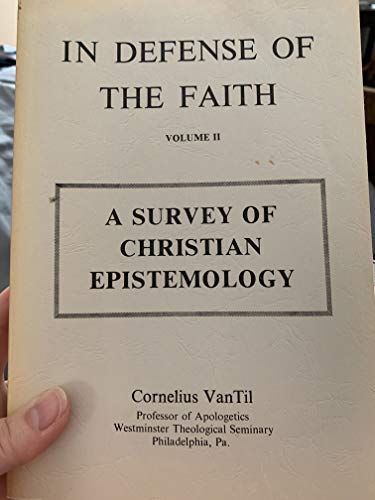
Cornelius Van Til — Reformed Epistemology
As an Amazon Associate, Postmilstill earns from qualifying purchases.
Citation look off? Sign in to suggest a source or rate accuracy.
Where this is from
Work title, edition, or primary text used to cite this quote.
As an Amazon Associate, Postmilstill earns from qualifying purchases.
Margin notes
Discussion
Share context, ask questions, or discuss this quote. Comments are separate from source proposals and verification ratings.
No comments yet.
Loading…