Needs review
Added by Postmilstill archive ·
God therefore makes him just whom he justifies, not in himself as if from a sight of his inherent righteousness he declared him just, but from the view of the righteousness, imputed, of Christ.
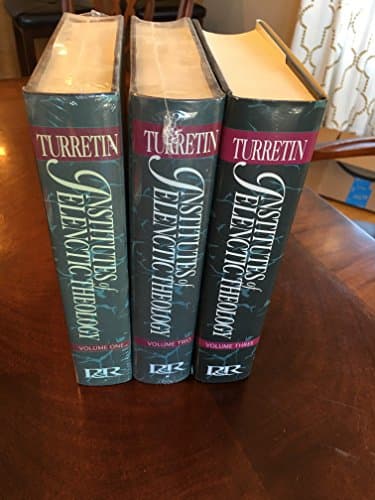
As an Amazon Associate, Postmilstill earns from qualifying purchases.
Free online editions of this work linked from the archive.
God therefore makes him just whom he justifies, not in himself as if from a sight of his inherent righteousness he declared him just, but from the view of the righteousness, imputed, of Christ.
As therefore accusation and condemnation occur only in a trial; so also justification.
XXV. If the Son of God assumed our nature, nothing on that account was added to him intrinsically to perfect his nature (which already had in an eminent degree all the perfection of humanity). Only extrinsically was some…
The church is called 'the pillar and ground of the truth' (1 Tim. 3:15) not because she supports and gives authority to the truth (since the truth is rather the foundation upon which the church is built, Eph. 2:20), but…
The contradictions (antilogia) found in Scripture are apparent, not real; they are to be understood only with respect to us who cannot comprehend and perceive the agreement everywhere, but not in the thing itself. And if…
It is not always necessary that a thing should be proved by something else. For there are some things which are self-evident accordingto the philosophers (as the highest categories of things, and ultimate differences and…
The passage of Augustine, "I would not believe the gospel if the authority of the church did not move me" (Against the Epistle of Manichaeus Called Fundamental 5 [NPNF1, 4:131; PL 42.176]) does not favor the papists. Fir…
The passage of Augustine, "I would not believe the gospel if the authority of the church did not move me" does not favor the papists. First, Augustine speaks of himself as still a Manichean and not yet a Christian. What…
Although all things are not written severally (kata meros) as to words and deeds (since there is neither a number nor science of singulars, of which Jn. 20:30 treats), yet they are written as to form (kat'eidos), as to t…
Although all things are not written severally as to words and deeds (since there is neither a number nor science of singulars, of which Jn. 20:30 treats), yet they are written as to form (kat'eidos), as to the substance…
The testimony of the prophets and apostles is unexceptionable and cannot reasonably be called in question by anyone. For if it were uncertain and fallacious, it would be questionable either because they themselves were d…
No fit reason can be given why God should wish one part of his word to be written and the other to be delivered by spoken voice. And he would have strangely consulted the interests of his church, if he had entrusted a ne…
It is not always necessary that a thing should be proved by something else. For there are some things which are self-evident accordingto the philosophers (as the highest categories of things, and ultimate differences and…
For some [Papists] (gymne te kephale, without wish of concealment) altogether deny the authenticity (authentian) of Scripture in itself without the testimony of the church and think it worthy of no more belief (I shudder…
Was it necessary for the word of God to be committed to writing? We affirm... Three things particularly prove the necessity of the Scripture: (1) the preservation of the word; (2) its vindication; (3) its propagation. It…
The oral (agraphous) traditions of the papists, for they speak diversely of them. Sometimes tradition is used by them for the "act of tradition" by which the sacred books were preserved by the church in an uninterrupted…
The question is not whether the Holy Scriptures are perspicuous in all their parts so as to need no interpreter nor exposition of doubtful passages (which Bellarmine falsely and slanderously charges upon us, stating the…
19 quotes
God therefore makes him just whom he justifies, not in himself as if from a sight of his inherent righteousness he declared him just, but from the view of the righteousness, imputed, of Christ.
As therefore accusation and condemnation occur only in a trial; so also justification.
XXV. If the Son of God assumed our nature, nothing on that account was added to him intrinsically to perfect his nature (which already had in an eminent degree all the perfection of humanity). Only extrinsically was some…
The church is called 'the pillar and ground of the truth' (1 Tim. 3:15) not because she supports and gives authority to the truth (since the truth is rather the foundation upon which the church is built, Eph. 2:20), but…
The contradictions (antilogia) found in Scripture are apparent, not real; they are to be understood only with respect to us who cannot comprehend and perceive the agreement everywhere, but not in the thing itself. And if…
It is not always necessary that a thing should be proved by something else. For there are some things which are self-evident accordingto the philosophers (as the highest categories of things, and ultimate differences and…
The passage of Augustine, "I would not believe the gospel if the authority of the church did not move me" (Against the Epistle of Manichaeus Called Fundamental 5 [NPNF1, 4:131; PL 42.176]) does not favor the papists. Fir…
The passage of Augustine, "I would not believe the gospel if the authority of the church did not move me" does not favor the papists. First, Augustine speaks of himself as still a Manichean and not yet a Christian. What…
Although all things are not written severally (kata meros) as to words and deeds (since there is neither a number nor science of singulars, of which Jn. 20:30 treats), yet they are written as to form (kat'eidos), as to t…
Although all things are not written severally as to words and deeds (since there is neither a number nor science of singulars, of which Jn. 20:30 treats), yet they are written as to form (kat'eidos), as to the substance…
The testimony of the prophets and apostles is unexceptionable and cannot reasonably be called in question by anyone. For if it were uncertain and fallacious, it would be questionable either because they themselves were d…
No fit reason can be given why God should wish one part of his word to be written and the other to be delivered by spoken voice. And he would have strangely consulted the interests of his church, if he had entrusted a ne…
It is not always necessary that a thing should be proved by something else. For there are some things which are self-evident accordingto the philosophers (as the highest categories of things, and ultimate differences and…
For some [Papists] (gymne te kephale, without wish of concealment) altogether deny the authenticity (authentian) of Scripture in itself without the testimony of the church and think it worthy of no more belief (I shudder…
Was it necessary for the word of God to be committed to writing? We affirm... Three things particularly prove the necessity of the Scripture: (1) the preservation of the word; (2) its vindication; (3) its propagation. It…
The oral (agraphous) traditions of the papists, for they speak diversely of them. Sometimes tradition is used by them for the "act of tradition" by which the sacred books were preserved by the church in an uninterrupted…
The question is not whether the Holy Scriptures are perspicuous in all their parts so as to need no interpreter nor exposition of doubtful passages (which Bellarmine falsely and slanderously charges upon us, stating the…