Welcome

Thanks for checking out the site! Feel free to poke around and don't worry if you break things, (we're in early development).

Archive
Needs sources

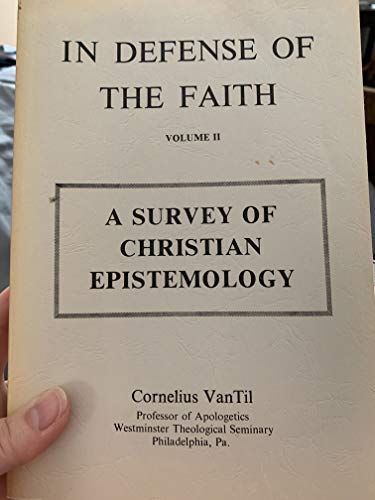
A survey of by Cornelius Van Til

Added by Postmilstill archive ·

The difference between Plato and Augustine on this most fundamental point of the position of God in the Ideal world may still more clearly be observed if we notice theargument each one gives for holding to his own position. Plato says that to appeal to therevelation of God is really to give up philosophy altogether. He says that we may ask the oracles of the gods when we have to give up philosophy in despair, but not till then. He would not appeal to what he considered foreign aid until his own efforts were proved useless. And even then he did not really expect any help from the ancients or from the oracles. On the other hand, Augustine is equally convinced that unless human knowledge has the right to appeal to divine knowledge, not as to a foreign something, there will be no knowledge for man. He feels that unless we can appeal to God we may as well give up philosophy. So far from subtracting from certainty of human knowledge, the appeal to divine revelation makes it all the more certain. 'The ultimate ground of our certitude becomes our confidence in God. In the last analysis, God is our surety for the validity of our knowledge; and that not merely remotely, as the author of our faculties of knowing, but also immediately as the author of our every act of knowing, and the truth which is known.

Source Evidence

A survey of
A survey of Christian epistemology

Community verification

Help verify accuracy, sources, and attribution. Pick one action below — you don't need to fill out everything.

Needs sources

0 ratings

Rate this quote (sign in required)

Sign in to rate this quote and affect community trust scores.

Contribute

Choose what you want to add. Each option opens its own short form.

Discussion

Share context, ask questions, or discuss this quote. Comments are separate from source proposals and verification ratings.

All discussions →

    No comments yet.

Related Quotes

Related by source, book, author, or topic.

Added by Postmilstill archive ·

The criticism that is valid against Kant is valid against later idealism as well. All idealism is at a loss to interpret the phenomenon of error or evil. As was already noted earlier it will not do to limit the question…

Added by Postmilstill archive ·

If there are no brute facts, if brute facts are mute facts, it must be maintained that all facts are revelational of the true God. If facts may not be separated from faith, neither may faith be separated from facts. Ever…

Added by Postmilstill archive ·

he Christian apologist must place himself upon the position of his opponent, assuming the correctness of his method merely for argument's sake, in order to show him that on such a position the 'facts' are not facts and t…

Added by Postmilstill archive ·

Now the question is not whether the non-Christian can weigh, measure, or do a thousand other things. No one denies that he can. But the question is whether on his principle the non-Christian can account for his own or an…

Added by Postmilstill archive ·

It ought to be pretty plain now what sort of God I believe in. It is God, the All-Conditioner. It is the God who created all things, Who by His providence conditioned my youth, making me believe in Him, and who in my lat…

Cornelius Van Til · What I Believe and Why I Believe What I Believe
Open quote →
Added by Postmilstill archive ·

But if it be said to such opponents of Christianity that, unless there were an absolute God their own questions and doubts would have no meaning at all, there is no argument in return.